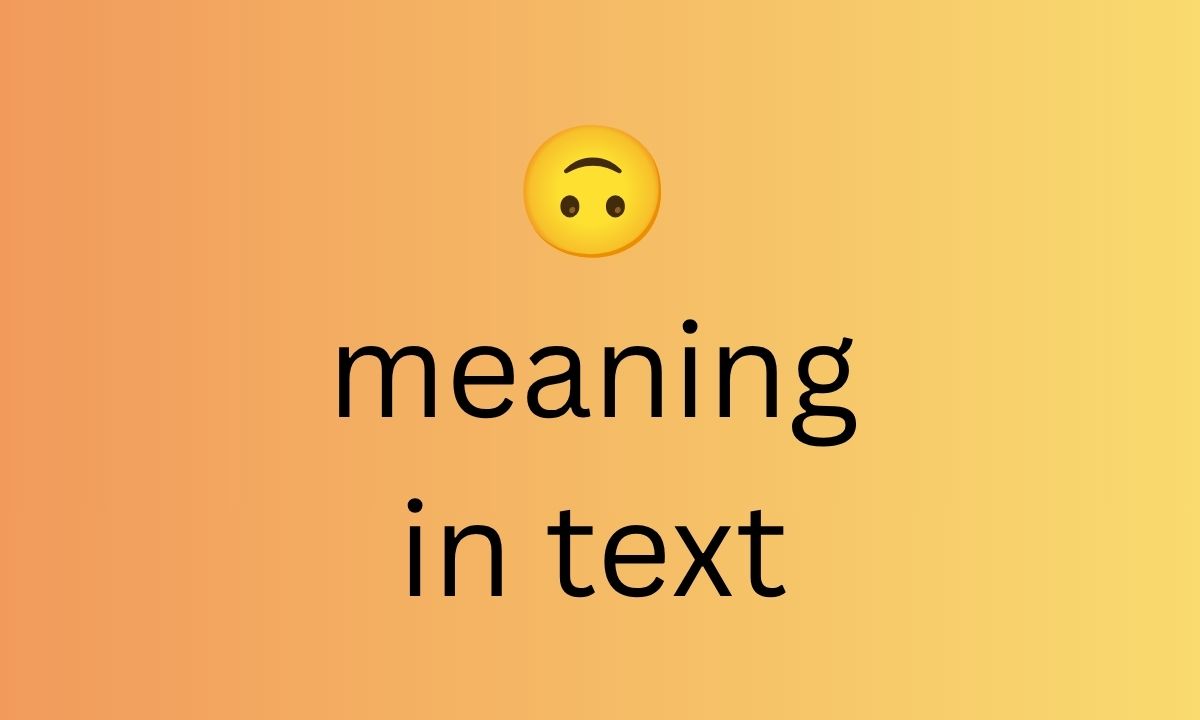
🙃 meaning in text
Featured Snippet: The Quick Answer The 🙃 meaning in text is primarily used to express sarcasm, irony, silliness, or passive-aggression. Because it is literally a standard smile turned upside down, it signals that a situation is not actually okay, the sender is “smiling through the pain,” or they are being playfully foolish.
Have you ever received a text from a friend that simply said, “Great, another flat tire 🙃,” and found yourself wondering if they were actually happy about it? If you are trying to figure out the 🙃 meaning in text, you are definitely not alone. This little yellow face is easily one of the most versatile, nuanced, and misunderstood emojis in our modern digital dictionary.
Unlike a standard laughing face or a simple heart, the upside-down smile carries a lot of hidden baggage. It is the emoji equivalent of a tight-lipped smile when you are secretly furious. In this comprehensive guide, we will break down exactly what this emoji means, explore how different generations use it in 2026, and show you exactly how to reply when it pops up in your inbox. Whether you are a teen trying to decode a crush’s text or a parent trying to understand your child’s messages, this guide has you covered.
What Does the 🙃 Emoji Mean?
To truly understand the 🙃 meaning in text, we have to look at the psychology behind digital body language. The upside-down face emoji was officially added to the Unicode Consortium in 2015 as part of Emoji 1.0. Initially, it was intended to represent silliness, goofiness, or irony. However, as text-based communication has evolved, so has the way we use this specific character.
By 2026, the 🙃 slang usage has shifted significantly. Digital communication studies from 2026 show that the upside-down face is now heavily relied upon to convey cognitive dissonance—the mental conflict that occurs when your outward expression does not match your internal feelings. It is the visual representation of saying “I’m fine” when you are absolutely not fine.
The core 🙃 meaning in text revolves around a few key emotional states:
- Sarcasm and Irony: It flips a positive emotion (a smile) on its head to indicate the exact opposite meaning.
- Resignation: It shows that you are accepting a terrible situation with a sense of humorous defeat.
- Passive-Aggression: It masks annoyance or frustration behind a fake, polite smile.
- Silliness: In lighter contexts, it simply means you are being goofy, derpy, or acting foolish.
Understanding the 🙃 meaning in text requires you to read the room. The exact interpretation depends entirely on the conversation preceding it, the relationship you have with the sender, and the specific platform you are using.
🙃 Emoji Full Form Explained
While text acronyms like LOL or ISTG have literal “full forms” (Letter by Letter), emojis do not work the same way. However, to satisfy the curiosity of those looking for the 🙃 full form, we can break down its official Unicode designation and its visual anatomy.
The official Unicode name for this emoji is the “Upside-Down Face.” If we break down its “full form” conceptually, we can understand why it carries such a complex emotional weight.
| Component | Official / Visual Breakdown | Meaning in Context |
|---|---|---|
| Official Name | Upside-Down Face | Indicates a subversion of normal facial expressions. |
| Visual Base | Slightly Smiling Face (🙂) | Provides the base emotion of a polite, closed-mouth smile. |
| Visual Modifier | 180-Degree Inversion | Flips the smile to show that the situation is “upside down” or wrong. |
| Primary Emotion | Sarcasm / Passive-Aggression | Shows that the sender is masking true frustration with a fake smile. |
| Secondary Emotion | Silliness / Resignation | Shows the sender is laughing at their own mistakes or accepting a bad fate. |
When you see this 🙃 in texting, you are essentially looking at a visual pun. It takes a universally recognized symbol of happiness and turns it upside down to show that the current situation is anything but happy.
How to Use 🙃 Emoji — Real Examples
Context is everything when it comes to emoji usage. To help you master the 🙃 meaning in text, we have compiled a list of real-world scenarios. Here is how you can use this emoji across different emotional contexts.
| Situation | Example Text | Emotion Conveyed |
|---|---|---|
| Minor Inconvenience | “I just spilled coffee on my white shirt right before the meeting 🙃” | Frustration masked by humor; smiling through the pain. |
| Heavy Sarcasm | “Oh great, the boss just scheduled a two-hour meeting for 4:55 PM 🙃” | Deep annoyance and irony; the opposite of excitement. |
| Goofy Mistake | “I spent 10 minutes looking for my phone while I was holding it 🙃” | Silliness; making fun of your own lack of awareness. |
| Passive-Aggression | “Thanks for loading the dishwasher the right way for once 🙃” | Polite but biting sarcasm; highlighting a recurring annoyance. |
| Smiling Through Pain | “My car just broke down on the highway, but sure, today is going awesome 🙃” | Resignation; accepting a terrible situation with dark humor. |
| Awkward Confession | “I just waved at someone who was actually waving at the person behind me 🙃” | Second-hand embarrassment; wanting to disappear. |
| Playful Teasing | “You’re 30 minutes late again, I’m shocked 🙃” | Lighthearted annoyance among close friends. |
| Overwhelmed but Coping | “I have five essays due tomorrow and I haven’t started 🙃” | Stress and panic, using humor to keep from crying. |
| Ironic Excitement | “Can’t wait to spend my Saturday cleaning the garage 🙃” | Pure sarcasm; dreading the task at hand. |
| Defeat / Giving Up | “I tried to fix the leaky sink and now the kitchen is flooded 🙃” | Total resignation; accepting that you have made things worse. |
As these 🙃 examples show, the emoji acts as a tone indicator. It tells the reader, “I am saying something positive or neutral, but my actual internal state is chaotic, annoyed, or silly.”
🙃 Emoji on Different Platforms (2026)
The 🙃 meaning in text can shift slightly depending on the social media platform you are using. Digital trends in 2026 highlight distinct behavioral patterns across major apps.
On WhatsApp
WhatsApp is heavily used for both family group chats and professional communication. In 2026, the 🙃 meaning in text on WhatsApp is heavily defined by a generational divide. Older generations (Gen X and Boomers) often still use the emoji in its original, literal sense: to show they are being silly or playful. However, Millennials and Gen Z use it almost exclusively for sarcasm or mild frustration. If your parents send it to you in a family group chat, they probably just think it looks funny. If your coworker sends it, they are likely annoyed.
On Snapchat
Snapchat is a highly visual, fast-paced platform. Here, the upside-down face is frequently used in quick text overlays on photos. If a user sends a selfie with the 🙃 emoji, it usually leans toward the “goofy” or “derpy” side of the spectrum. However, if it is sent over a black screen or a picture of the ceiling late at night, the 🙃 slang meaning shifts to existential dread or sadness. It is the go-to emoji for “my life is a mess, but I’m laughing about it.”
On TikTok
TikTok’s comment section is a unique landscape of irony and humor. In 2026, TikTok users utilize the 🙃 emoji heavily for “delulu” (delusional) humor or ironic detachment. You will often see it used in comments on chaotic, relatable, or slightly embarrassing videos. It signals that the commenter relates to the video’s disaster but is viewing it through a lens of humorous resignation. It is the ultimate emoji for “I am in my flop era.”
On Instagram
On Instagram, the emoji is a staple in Direct Messages (DMs) and Stories. In 2026, Instagram users frequently pair the 🙃 emoji with aesthetic but chaotic photos—like a beautifully filtered picture of a messy bedroom or a burnt dinner. It is used to convey self-deprecating humor. In DMs, it serves the same purpose as on WhatsApp: softening the blow of a sarcastic remark or expressing mild, polite annoyance.
Is 🙃 Emoji Rude or Offensive?
A very common question is whether the 🙃 meaning in text crosses the line into rudeness. The short answer is: no, it is not inherently offensive. It does not contain profanity, explicit gestures, or hateful symbolism. You will not get banned from any platform for using it.
However, it can be highly passive-aggressive, which some people find incredibly rude.
Because the emoji represents a fake smile, using it during a serious argument or a sensitive conversation can be deeply invalidating. If someone is expressing genuine anger or sadness, and you reply with a 🙃, it signals that you are not taking their feelings seriously. It says, “I am smiling at your distress,” which can easily escalate a conflict.
Furthermore, in a strictly professional environment, such as an email to a client or a formal Slack message to your boss, using this emoji is highly discouraged. The 🙃 in texting is best reserved for casual conversations with friends, family, or peers who understand your sense of humor. Context and audience are the ultimate deciders of whether this emoji is perceived as a funny joke or a rude dismissal.
How to Reply to 🙃 Emoji
Deciding how to respond to this emoji can be tricky. Since the 🙃 meaning in text varies so wildly, your reply should match the underlying emotion of the sender. Here is a guide on how to respond effectively.
| Scenario | Strategy | Example Reply |
|---|---|---|
| They are venting about a bad day | Show empathy and validate their frustration. | “Oh no! That is the absolute worst. Let me buy you a coffee to make up for it.” |
| They are being highly sarcastic | Match their sarcasm and lean into the joke. | “Wow, what a truly blessed and lucky day we are having. Enjoy the chaos!” |
| They made a silly, harmless mistake | Laugh it off and share a similar experience. | “Classic you! Don’t worry, yesterday I put the milk in the cupboard.” |
| They are being passive-aggressive with you | Address the underlying issue calmly and directly. | “Hey, it feels like you’re annoyed with me. Did I do something to upset you?” |
| They are clearly overwhelmed and stressed | Offer tangible help or a listening ear. | “Take a deep breath. What is one thing I can take off your plate right now?” |
| You don’t know how to react to the chaos | Send a validating, sympathetic emoji response. | Reply with the melting face (🫠), skull (💀), or loudly crying face (😭). |
The key to replying to the 🙃 examples you receive is to look at the text accompanying the emoji. If the text is negative, offer sympathy. If the text is overly positive but the situation is bad, match the sarcasm.
🙃 Emoji Alternatives and Similar Slang
Emoji fatigue is real, and sometimes the upside-down face just doesn’t capture the exact vibe you are going for. If you want to mix up your digital vocabulary, here are some excellent alternatives and similar 🙃 slang terms that convey related emotions.
| Term / Emoji | Meaning and Usage Context |
|---|---|
| 🙂 (Slightly Smiling Face) | Often used as a “death stare” or to convey polite disgust, deep disappointment, or passive-aggression. |
| 🫠 (Melting Face) | Represents extreme embarrassment, dread, or feeling completely overwhelmed. The 2026 favorite for “I want to disappear.” |
| 😭 (Loudly Crying Face) | Used ironically to represent something that is funny, slightly annoying, or overwhelmingly cute. |
| 💀 (Skull) | Means “I’m dead.” Used when something is hilarious, or when you die of second-hand embarrassment. |
| 🤡 (Clown Face) | Used to call yourself (or someone else) a fool for making a stupid mistake or trusting someone you shouldn’t have. |
| “It is what it is” | The verbal equivalent of the 🙃 emoji. Used to express total resignation to a bad situation that cannot be changed. |
| “I’m fine” | When typed in all lowercase (“i’m fine”), it is the textual equivalent of the upside-down smile. It means you are absolutely not fine. |
| “Send help” | A dramatic, humorous slang phrase used when you are overwhelmed with work, school, or life in general. |
Using these alternatives allows you to express the 🙃 meaning in text with slightly different flavors of sarcasm, dread, or goofiness, keeping your conversations fresh and expressive.
Frequently Asked Questions (FAQ)
Q1: What does the 🙃 emoji mean from a girl or guy? A: The 🙃 meaning in text does not change based on gender. Whether a guy or a girl sends it, it generally means they are being sarcastic, smiling through a frustrating situation, or acting goofy. However, if a guy sends it while playfully teasing you, it is often a sign of flirting and lighthearted banter. Always look at the surrounding text to determine the exact tone.
Q2: Is the 🙃 emoji considered passive-aggressive? A: Yes, it can be. While it is often used for harmless silliness, the upside-down face is widely recognized as a tool for passive-aggression. It allows the sender to express annoyance or frustration while maintaining a veneer of politeness. If used in an argument, it is almost always interpreted as passive-aggressive.
Q3: What is the difference between the 🙂 and 🙃 emojis? A: The standard slightly smiling face (🙂) is often used in 2026 to convey a “death stare,” polite disgust, or deep disappointment. It is a tight, unamused smile. The upside-down face (🙃), on the other hand, is more chaotic. It conveys sarcasm, silliness, or the feeling of “smiling through the pain.” The 🙂 is quiet anger; the 🙃 is chaotic, humorous frustration.
Q4: Does sending 🙃 mean the person is flirting? A: Not usually, but it can be a sign of playful banter. If the conversation is already flirty and they use the 🙃 emoji to tease you about a minor mistake or a silly comment, it is a good sign. It shows they are comfortable enough to be goofy and sarcastic with you. However, on its own, it is not a universal symbol of romance.
Q5: How do you use the 🙃 emoji in a sentence correctly? A: To use it correctly, place it at the very end of a sentence that describes a mildly frustrating, ironic, or silly situation. For example: “I just locked my keys in the car 🙃.” The emoji acts as a punctuation mark that completely changes the tone of the sentence from a simple statement of fact to a humorous expression of defeat.
Mastering the nuances of digital body language is essential for clear communication. The 🙃 meaning in text is a perfect example of how a simple yellow circle can convey a massive spectrum of human emotion, from pure goofiness to deep, sarcastic resignation. By understanding the context, the platform, and the generational differences in how this emoji is used, you can confidently navigate any text conversation in 2026.
Bookmark this page so you never have to guess what your friends, family, or coworkers mean when this upside-down smile pops up on your screen. If you found this guide helpful, share it with that one friend who absolutely refuses to stop using this emoji!
About the Author